
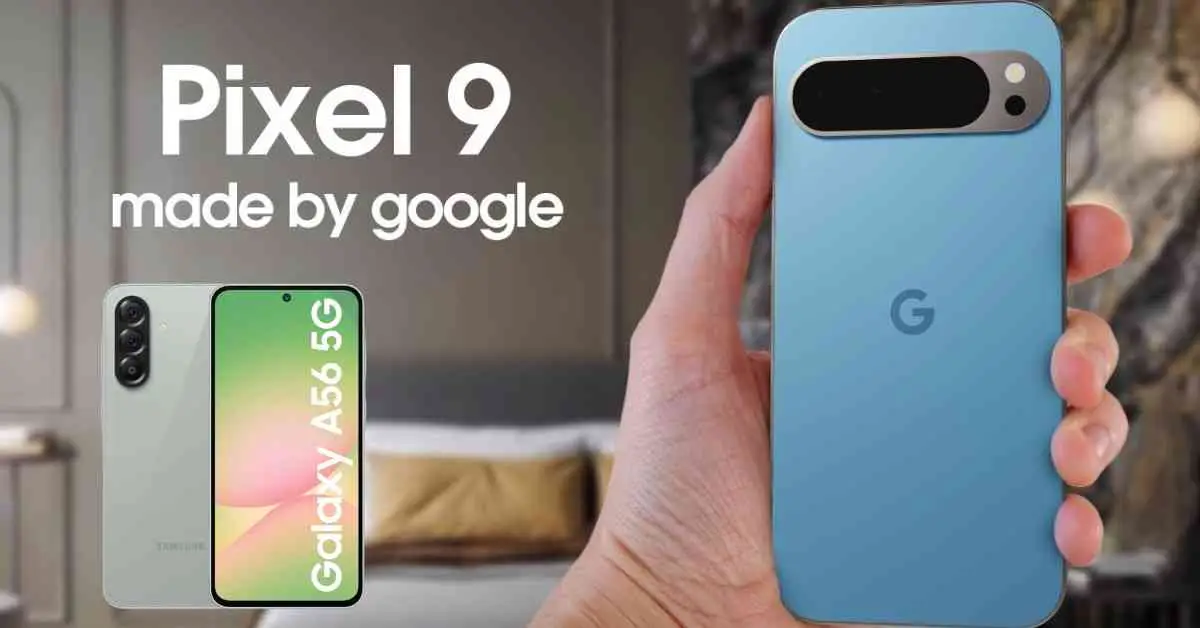
In the world of smartphones, the “middle ground” has officially become the “high ground.” Gone are the days when buying a mid-range phone meant settling for grainy cameras and plastic bodies that creaked under pressure. As we move through 2026, two titans have emerged to claim the throne of the $500 category: the Samsung Galaxy A56 and the Google Pixel 9a.
If you are currently holding an older device and wondering which of these two will serve you better for the next four to five years, you aren’t alone. This is the most asked question in our community this year. Below is a deep-dive analysis into the performance, optics, and everyday utility of these two powerhouses.
Samsung Galaxy A56 Design: Aesthetics Meets Ergonomics
The Samsung Galaxy A56 is a masterclass in industrial design. Samsung has managed to shave the thickness down to a staggering 7.1mm without sacrificing battery capacity. It feels like a piece of jewelry—dense, premium, and sleek. The use of “Glastic 2.0” on the back feels indistinguishable from the Gorilla Glass Victus 2 used on their flagship models, offering a matte finish that resists fingerprints beautifully.
The Google Pixel 9a, conversely, embraces its “Google-ness.” It retains the iconic horizontal camera bar, though it is more flush with the body than previous generations. It’s a bit chunkier than the Samsung, but that extra girth makes it feel incredibly robust. For users who find slim phones slippery, the Pixel 9a offers a reassuring grip.
- Samsung Advantage: Better screen-to-body ratio and a more “modern” look.
- Google Advantage: Unique identity and superior drop-resilience due to its rounded frame.
Samsung Galaxy A56 vs. Google Pixel 9a Display: The Battle of Nits and Hues
Samsung has long been the king of displays, and the Samsung Galaxy A56 continues that legacy. Its 6.7-inch Super AMOLED panel features a “Vision Booster” algorithm that adjusts color contrast based on ambient light. Even under the direct 2026 summer sun, the screen remains perfectly legible.
The Google Pixel 9a counters with its “Actua Display” technology. While smaller at 6.3 inches, it actually hits a higher peak brightness (2700 nits) than the Samsung. This makes the Pixel a superior choice for HDR content. However, the Samsung’s 120Hz refresh rate feels slightly more optimized within the One UI interface, resulting in animations that look like liquid silk.
Performance: Exynos 1680 vs. Tensor G4
The engine room is where these two diverge significantly. The Samsung Galaxy A56 uses the Exynos 1680, a chip built on a 4nm process that prioritizes thermal efficiency. In our stress tests, the A57 maintained 90% of its peak performance after an hour of gaming. It’s a reliable workhorse that doesn’t get uncomfortably hot.
The Google Pixel 9a uses the Tensor G4. While it doesn’t win the raw “speed” race against the Exynos, it wins the “intelligence” race. The Tensor G4 features a dedicated TPU (Tensor Processing Unit) that handles on-device AI. This allows the Pixel to perform real-time translation, voice-to-text with perfect punctuation, and “Magic Eraser” edits without needing an internet connection.
Pro Tip: If you are a mobile gamer, the Samsung Galaxy A56 is your pick. If you are a productivity power-user who dictates emails and uses AI assistants, the Google Pixel 9a is unbeatable.
Camera: Hardware vs. Software
The Samsung Galaxy A56 sports a 50MP main sensor with a larger aperture than last year. In daylight, the colors are “Samsung-standard”—vibrant, punchy, and ready for Instagram without a filter. The macro lens is a nice addition, though many users may find it niche.
The Google Pixel 9a, despite having fewer lenses, produces photos that tell a story. Google’s computational photography remains the gold standard. Its “Real Tone” technology ensures skin tones are captured with surgical accuracy, and “Night Sight” still leads the industry in capturing detail in near-total darkness.
One major win for the Samsung Galaxy A56 in the camera department is video. The OIS (Optical Image Stabilization) on the A57 is remarkably steady, making it a better tool for vloggers and TikTok creators who are often on the move.
Battery Life and Charging: The Great Divide
This is perhaps the most significant “make or break” factor for users.
- Samsung Galaxy A56: Supports 45W fast charging. You can get from 0% to 70% in about 30 minutes.
- Google Pixel 9a: Still lingers at 18W–22W wired charging speeds. It takes over an hour to reach a full charge.
In 2026, where our lives move at light speed, Google’s slow charging feels like a relic of the past. The Samsung Galaxy A56 wins this category by a landslide, especially considering both phones comfortably last a full day of heavy use.
Software and Longevity
Both brands have stepped up their game regarding sustainability.
- Samsung offers 6 years of OS updates.
- Google offers 7 years of OS updates.
Google’s “Pixel Experience” is clean, devoid of bloatware, and first in line for every new Android feature. Samsung’s One UI 8.5, however, offers more customization. If you like to change your icons, use “Edge Panels,” and multitask with “Pop-up View,” Samsung’s software is much more versatile.
Samsung Galaxy A56 vs. Google Pixel 9a Detailed Comparison Table
| Feature | Samsung Galaxy A56 | Google Pixel 9a |
| Display | 6.7″ Super AMOLED (120Hz) | 6.3″ Actua OLED (120Hz) |
| Chipset | Exynos 1680 | Google Tensor G4 |
| RAM | 8GB / 12GB | 8GB |
| Storage | 128GB/256GB + MicroSD | 128GB/256GB (No SD) |
| Charging | 45W Wired | 18W Wired |
| AI Features | Awesome Intelligence (Tools) | Gemini Integration (Assistant) |
| Video | Pro-Grade Stabilization | Standard OIS |
| Biometrics | In-display Fingerprint | Fingerprint + Face Unlock |
Summary + Final Advice
After spending a week with both the Samsung Galaxy A56 and the Google Pixel 9a, the verdict is clear.
The Winner for 2026 is the Samsung Galaxy A56.
While the Pixel 9a is a brilliant “smart” phone with a legendary camera, the Samsung Galaxy A56 is the better “daily” phone. It offers a larger, more immersive screen, faster charging that fits a busy lifestyle, and the flexibility of expandable storage—a rarity in 2026. Samsung has successfully bridged the gap between their flagship S-series and the A-series, giving you 90% of the premium experience for 50% of the price.
Choose the Samsung Galaxy A56 if: You prioritize battery charging speeds, gaming, and a large, beautiful screen for media consumption.
Choose the Google Pixel 9a if: You are a photography enthusiast who wants the smartest AI features and the cleanest software experience possible.
Start your journey with the Samsung Galaxy A56 today and experience the ultimate blend of power and elegance. Don’t miss out on the fastest charging and best display in its class. Get started now and take the first step towards upgrading your digital life!